



“Women in today’s politics are smart, married, classical, and certain of their femininity.” Tim Leonakis
‘Trumpet Edition’ contributor, Tim Leonakis, writes a thought-piece on the duality of women’s roles in politics through the lens of Western mythology—both as powerful leaders and humble protectors—and their essential contribution to the pursuit of happiness and peace.
Women in today’s politics are smart, married, classical, and certain of their femininity. They represent the pursuit of happiness—not just for themselves, but for their communities, nations, and the world. This is a far cry from the past, where we saw: Auto-gynaikophobes: Women who cowered from being women and Auto-androphobes: Men who cowered from being men.
Femininity cannot be defined without masculinity, nor masculinity without femininity. Both are essential, complementary forces. Yet, for too long, society has encouraged women to shrink from their power and men to reject their strength. Why cower from overcoming fear, pain, or psychological barriers? Let us instead look to the origins of Western mythology and history to understand the timeless role of women in politics.
The Origins: Wisdom and Strategy in Mythology
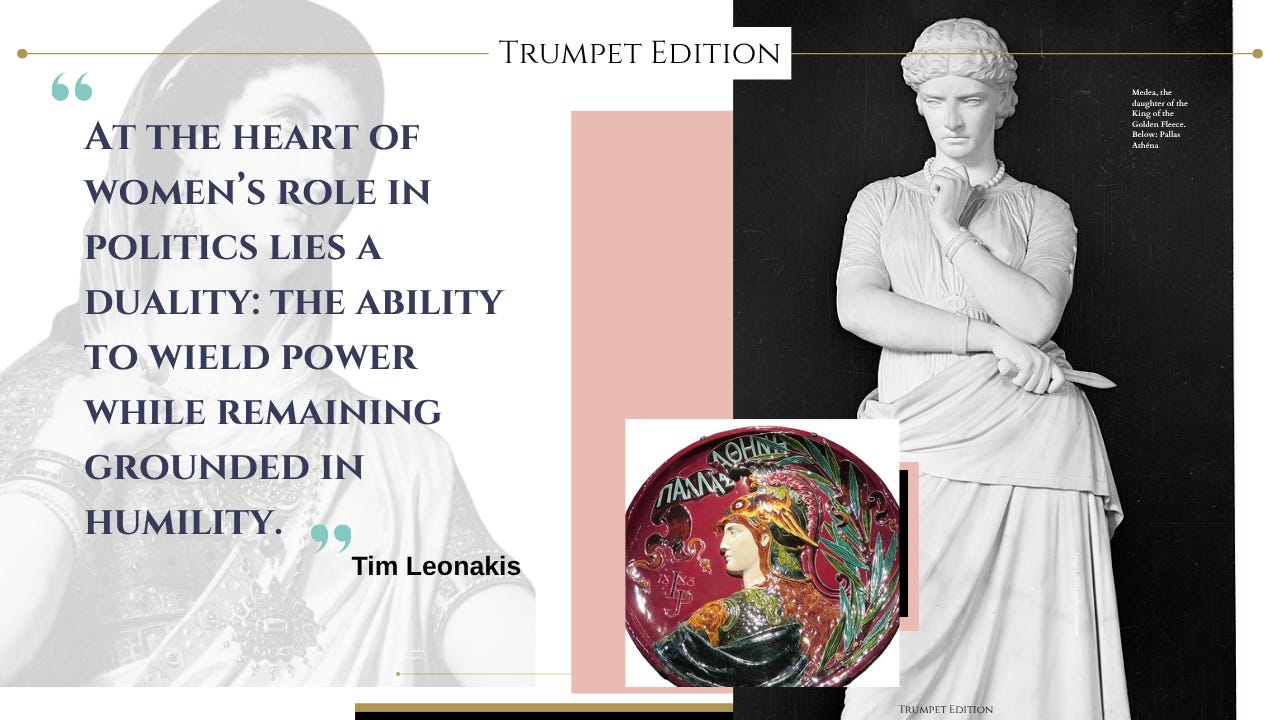
The oldest Western written mythology offers profound insights into the role of women in politics. Consider Medea, the daughter of the King of the Golden Fleece. She threw her lot in with Jason, betraying her kingdom to secure her future. While her actions were controversial, they underscore the strategic agency women have wielded for millennia.
Then there is Athena, the goddess of wisdom, who outmaneuvered Poseidon in the contest for the city that would bear her name. Poseidon offered a well of saltwater; Athena, an olive tree—the chief trading commodity of the time. The city chose wisdom over brute force, naming itself Athens. Athena’s cleverness didn’t stop there. She thwarted Poseidon at every turn, from transforming his nymphs into gorgons (like Medusa) to guiding Odysseus in his cunning escape from the Cyclops.
Athena embodies the abstract virtues of wisdom, patience, intelligence, hope, and faith—all expressed in Greek in the feminine gender. She is the archetype of the greater women in politics: those who lead not with force, but with intellect and vision.
Theatre and History: Women as Peacemakers and Leaders
In theatre, Lysistrata by Aristophanes presents a powerful vision of women’s influence. The play’s theme, “make love, not war,” highlights women’s unique ability to mediate and resolve conflict.
In history, women have played pivotal roles in shaping nations and cultures. Consider:
Roxana and Stateira, the wives of Alexander the Great, who bridged Bactrian, Sogdian, and Persian cultures to ensure peace.
Esther, the biblical orphan who became Queen of Persia and used her influence to save the Nation of Israel.
Queen Elizabeth I, who executed Mary, Queen of Scots, for treason but ensured Mary’s son would inherit the throne, uniting England and Scotland.
These women exemplify wisdom, patience, and the ability to see the bigger picture—qualities essential to effective leadership.
The American Experiment:
A Motherland, Not a Fatherland
The United States was founded on principles deeply tied to feminine symbolism. The signing of the Declaration of Independence on July 4, 1776, coincided with the sun’s conjunction with the constellation Cancer the Crab—a cardinal feminine water element. The U.S. is a motherland, not a fatherland, nurtured by figures like Betsy Ross and inspired by the French gift of The Statue of Liberty.
Women have continued to shape their nation’s destiny, from the suffragettes to modern leaders like Margaret Thatcher, Kay Bailey Hutchinson, and Jeanie Snow. These women have demonstrated that femininity and strength are not mutually exclusive but are, in fact, inseparable.
The Duality of Women in Politics:
Power and Humility
At the heart of women’s role in politics lies a duality: the ability to wield power while remaining grounded in humility. This is exemplified in the Apocalypse’s Harlot, who rides the sea beast but does not control it, and the Virgin Mary, who is protected by the Earth itself when threatened by the Dragon.
The Harlot represents the attraction to a malevolent politic, and persuades people to their destruction, while the Virgin Mary embodies humility and protection. Together, they illustrate the full spectrum of women’s influence in politics—both as powerful leaders and as guardians of peace and stability
Conclusion: The Essence of Women’s Polarity in Politics
Women in politics are not monolithic; they embody a rich polarity of strength and humility, wisdom and action, power and grace. From ancient mythology to modern leadership, they have shaped the course of history through their unique ability to navigate complexity and conflict.
As we look to the future, let us celebrate the women who continue to lead with intelligence, patience, and vision. They remind us that femininity is not a limitation but a source of immense power—one that has the potential to transform our world for the better.