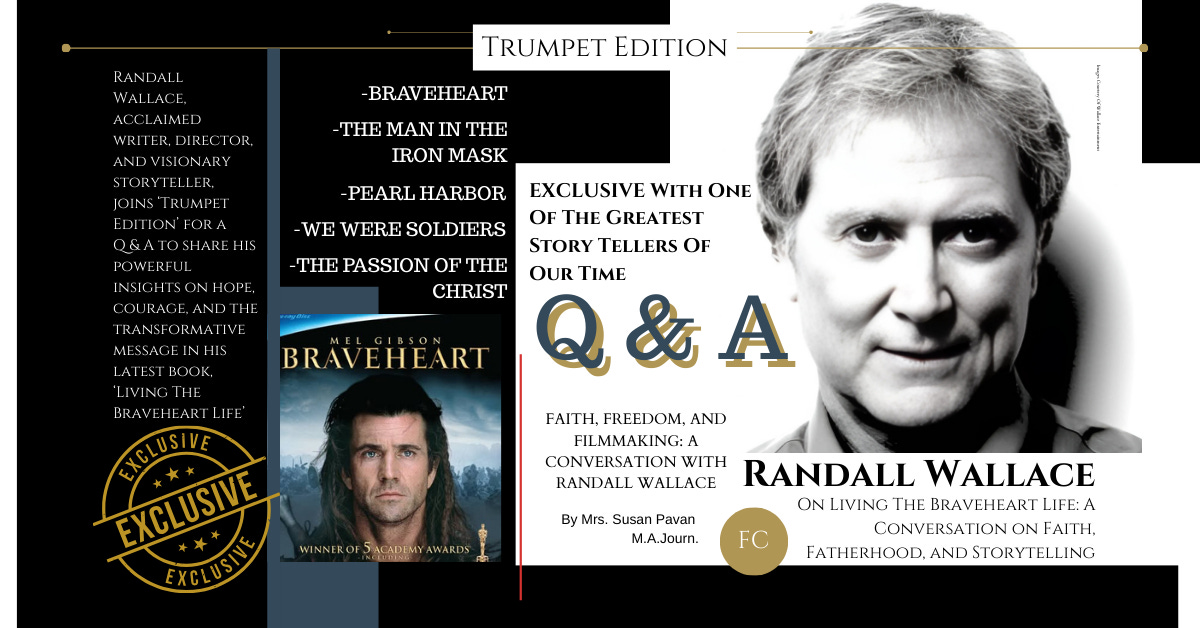
Randall Wallace On Living The Braveheart Life: A Conversation on Faith, Fatherhood, and Storytelling
EXCLUSIVE Q&A With One Of The Greatest Storytellers Of Our Time
Faith, Freedom, and Filmmaking: A Conversation with Randall Wallace.
Randall Wallace, acclaimed writer, director, and visionary storyteller, joins Trumpet Edition for a Q&A to share his powerful insights on hope, courage, and the transformative message in his latest book, Living The Braveheart Life.
On Faith, Fatherhood, and Legacy
Q: You’ve said your faith got you through tough times growing up. When life hit hard, your sons became the heart of your prayers. How has being a dad shaped your take on courage, sacrifice, and leaving a legacy—especially in your films?
A: Being a father to my three sons has been and continues to be one of my biggest sources of inspiration, the well from which I draw the courage to persist, and the reason for my sacrifice. Mentorship and fatherhood are a recurring theme in my work, from Uncle Argyle in Braveheart to Hal Moore in We Were Soldiers to Todd Burpo in Heaven Is for Real, each man served a powerful role to teach, to nurture, and to protect.
On the Spirit of Freedom
Q: In Braveheart you dig into the raw power of William Wallace’s battle cry: “They may take our lives, but they’ll never take our freedom!” I’ve seen that line electrify crowds—from corporate boardrooms to freedom rallies—every time, people stand taller, locked onto those words. When you wrote it, did you know it would hit that hard, crossing generations and cultures?
A: I think it’s natural for a writer to hope that every single line he writes will strike a chord with an audience, and since that speech comes at a pivotal turning point in the film and is meant to rally a crowd, I certainly wanted it to inspire the audience when I wrote it, but I can’t say that I knew it would have the staggering impact that it continues to have. The line that surprised me the most, though, is the quote that appeared on the US poster: “Every man dies, not every man really lives” because it came so naturally and freely during the writing process that I never considered it would rise above the others to become the tagline for the movie.
On Light and Darkness
Q: Your films don’t shy away from the darkness—war, betrayal, suffering. How do your characters ever find light in the middle of all that darkness and how is that relevant to what many people fight for freedom today?
A: The light is found in what you’re willing to die for, what you’re willing to fight for, the things you stand for. And while in today’s polarized environment we’re constantly being told our values are under attack, the truth is more nuanced. The challenge of life is in knowing when to pick up the sword, when to swing it, and when to leave it sheathed at your side because those precious few moments of grace that touch our lives are fleeting. You fight for freedom and rage against the darkness so that you can enjoy the light. One doesn’t have value without the other.
On the Power of Myth and Story
Q: C. S. Lewis called it “true myth”—stories that hit on something deeper, something universal, referring to the story of Christ that gives life. Does your work tap into that? How do you balance sticking to history with telling a story that is timeless?
A: I hope so, that’s always been the goal. Stories tell us who we are, they explore the deeper truths surrounding our lives. I’ve been derided occasionally over a loose quote I gave years ago, “don’t let the facts get in the way of the truth,” as if I don’t think that history matters. That’s demonstrably false given how often my work explores history, but it’s also true that I don’t stick directly to history when I write. There’s certainly a place for documentaries, but that’s not my business—I think of feature films more like impressionistic paintings rather than photographs. Like a magician performing the parlor trick of pulling out the table cloth while leaving the place settings undisturbed where it’s crucial to know where to grip the linen and how fast and hard to pull, the challenge for a writer is in knowing what details to highlight, what details to consolidate, and what details to omit to convey the true sentiment embodied in a story. Anything that taps into the timeless values of love, honor, and sacrifice is a winner.
On Faith in a Secular World
Q: Your movies hit with both believers and skeptics. How do you walk that line—making art that speaks to everyone without watering down your faith?
A: It’s about the approach I try to take: I make great movies that are compatible with my faith rather than trying to make a faith-based movie good. If a movie speaks to me, I know it’ll resonate with others, but the goal most of all needs to be telling a great story.
On the Antidote to Fear
Q: What’s your antidote to fear? Do you think courage is about conquering fear, or learning to move forward in spite of it?
A: Courage is about both conquering fear and learning to move forward in spite of it. There are two kinds of fear: the irrational kind that keeps us from doing the things we’re meant to do, and the kind of fear that tells us to pay attention because our lives might be at stake. It’s entirely reasonable for a paratrooper to be afraid before he jumps out of an airplane, and it’s crucial to use that fear to trigger careful attention to detail; trying to conquer and eliminate that fear is not just foolish, it’s dangerous. But the much more common fear, the one a psychologist might call False Evidence Appearing Real, is the one we need to conquer every single day. And the only antidote I know to the paralyzing fear of the unknown is to start down the path. It’s virtually impossible to ascertain a correct direction without movement.
On Creative Collaboration
Q: You’ve collaborated with Mel Gibson for decades. Could you describe the creative process behind your work partnership? For instance, how did the two of you approach writing a project like The Resurrection (working title)?
A: When you work with someone as passionate as Mel is, it’s easy to collaborate. Mel knows on a fundamental level what makes a movie irresistible to watch. When someone immediately understands what you’re trying to express without any explanation, as Mel and many of the other folks I’ve collaborated with repeatedly throughout my career have, of course you’ll continue to gravitate to those people. A quick glance at my credits bears this out first-hand both in front and behind the camera. I’m always looking for a way to cast actors like John Malkovich, Greg Kinnear, and Margo Martindale. The team behind the camera is just as important: once you find the right people, you don’t want to work with anyone else if you can help it. A huge part of enjoying your work is enjoying the people with whom you work.

Just some of the titles this prolific storyteller has shared with the world:
BRAVEHEART
THE MAN IN THE IRON MASK
PEARL HARBOR
WE WERE SOLDIERS
Randall Wallace is featured in our latest magazine, Trumpet Edition, Vol.2.


