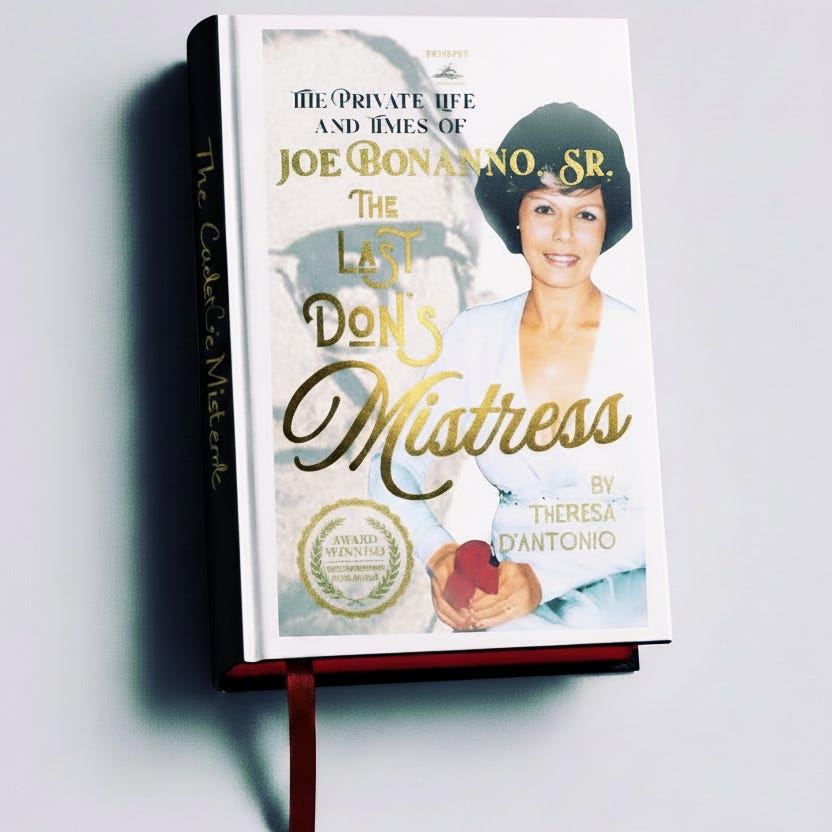
“I would never have imagined that my story would end there, in Tucson, Arizona, living in the home of a man feared by many, respected by some, and, for many years, loved by me.” Theresa D’Antonio, The Last Don’s Mistress
Editor’s Note
At 1:15 on the morning of May 9, 2002, in a Tucson hospital, a 97-year-old man whose life had been built on silence asked the woman at his bedside what time it was. Then he asked for the date, and told her to write it down. She had no paper, so she wrote it on a Kleenex box and held it up. He looked at it and said two words: “Memorable day.”
According to Theresa D’Antonio, there were no more words after that. Joseph Bonanno died two days later, on Saturday, May 11. She had stepped out to pray in the hospital chapel.
The obituaries called him a Mafia boss, and so he was. In the days of Charles “Lucky” Luciano, Joseph Bonanno, by his own account, sat on the Commission that ruled New York’s five families. Few from that era lived to see the twenty-first century. He did. The woman who lived beside him called him “The Last Godfather.”
His 1983 autobiography gave the public the composed, formal man. The private one, Theresa writes, was something only she saw: “I alone was privy to these secrets.”
Theresa reportedly kept notes and recorded their conversations on seven one-hour tapes that she says Bonanno approved. Of why he talked, she writes: “The reason for his candid disclosures to me, in this final chapter of his life, was that he wanted to help me author this book, so that the government and the public would finally know the shocking truths.”
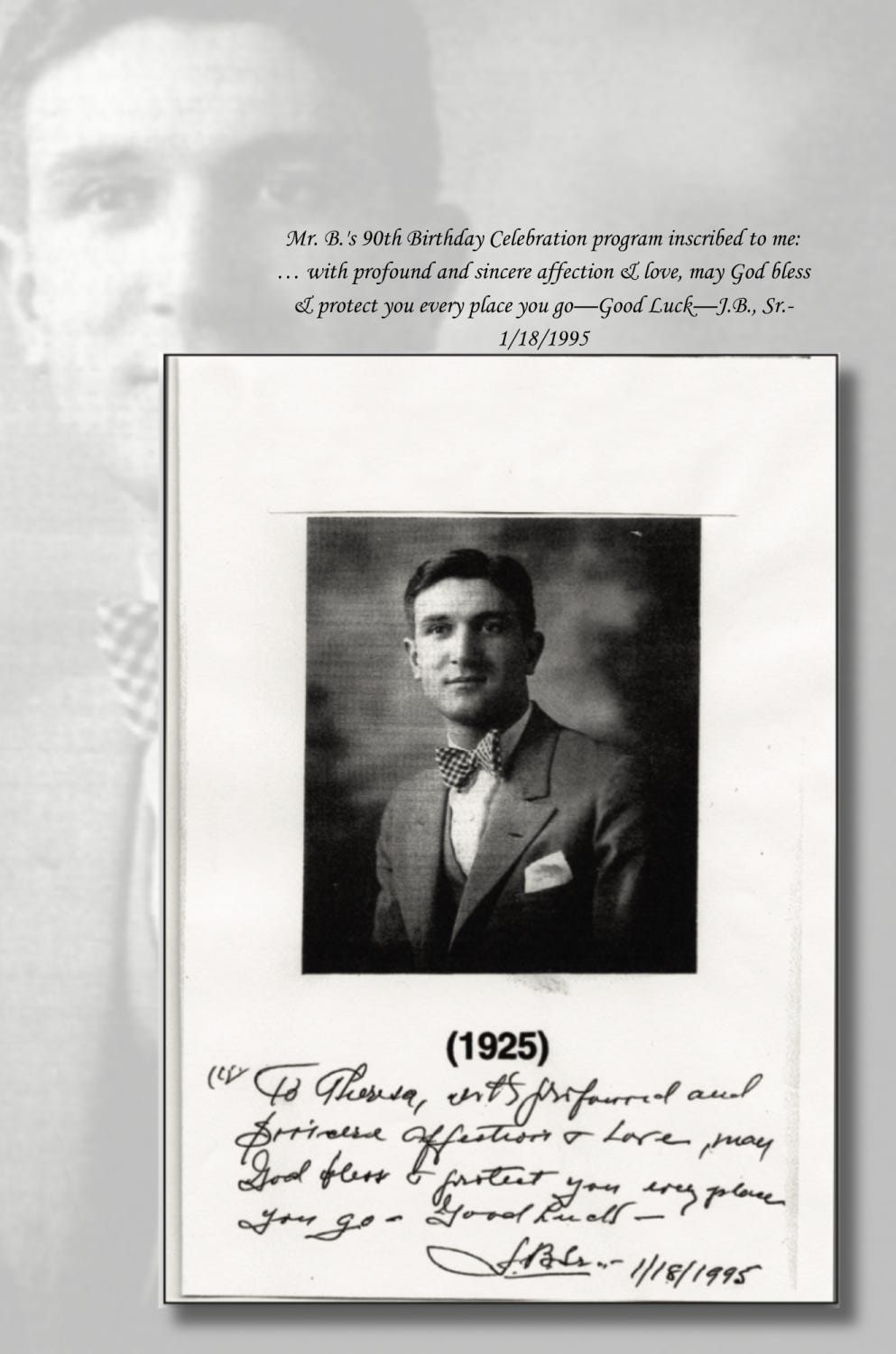
Part One: “Twenty-Five Egyptian Pounds”
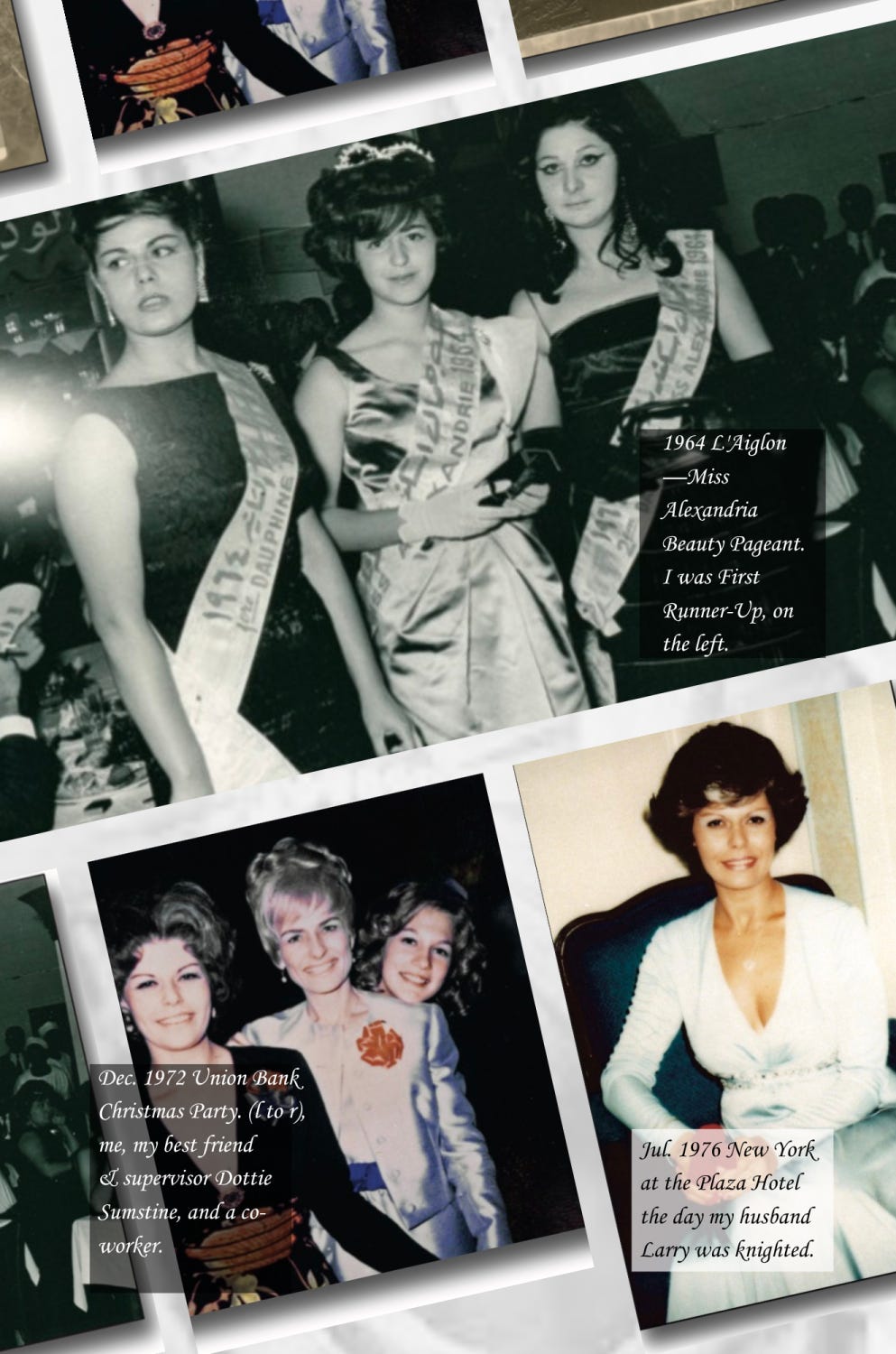
Before the Godfather, there was Alexandria. An excerpt from Chapter 1, “Egypt to Canada”
My journey from birth to living with and loving “The Last Godfather,” Joseph Bonanno, was a long and interesting one. I would never have imagined that my story would end there, in Tucson, Arizona, living in the home of a man feared by many, respected by some, and, for many years, loved by me.
I was born (and lived until I was age nineteen) in Alexandria, Egypt, to a well-known and respected family. My father came from a well-to-do Armenian family whose roots were from Batoum, a port city in the state of Georgia, which used to be part of the Russian Empire. My grandparents came to Alexandria, Egypt, in 1905 when my father was five. With the gold coins they had escaped with at the time of the 1905 Revolution, his father recreated the merchant business he had once owned in Russia, and purchased a large brick three-story apartment building, into which the family settled. · · ·
‘The Last Don’s Mistress’ featured on TikTok.
My father was a very generous person, and he loved to have a good time and made sure that his family and friends enjoyed themselves. Money was no object to him. He also believed in supporting those that were less fortunate. It was a beautiful life!
Unfortunately, this did not last. In the late 1950s, when Gamal Abd El Nasser gained power, he began to nationalize businesses, banks, and schools. In 1962, he nationalized my father’s import/export business, which, of course, caused us to make some changes in our lifestyle...
In 1962, after my father’s business had been nationalized, there was nothing left for my brother and me; so, in 1963, we applied for immigration to Montreal, Canada. Our choice of Montreal was based mainly on the language, as we both spoke French and English, and if we didn’t like Montreal, we could somehow move to the United States. The decision, of course, broke our parents’ hearts, though my father showed little emotion. My brother and I began the difficult process that was required in order to leave the country.
The procedure was complicated by the fact that my father was born in Armenia and was a White Russian. At age sixteen, we could have filed to become Egyptian citizens, but we had remained stateless. Due to this, we would be allowed to leave the country with only our clothes and 25 Egyptian pounds, which was the equivalent to US$43 at the time.
How they met. From Chapter 3, “Meeting Larry, Fay, and Joseph Bonanno, Sr.”
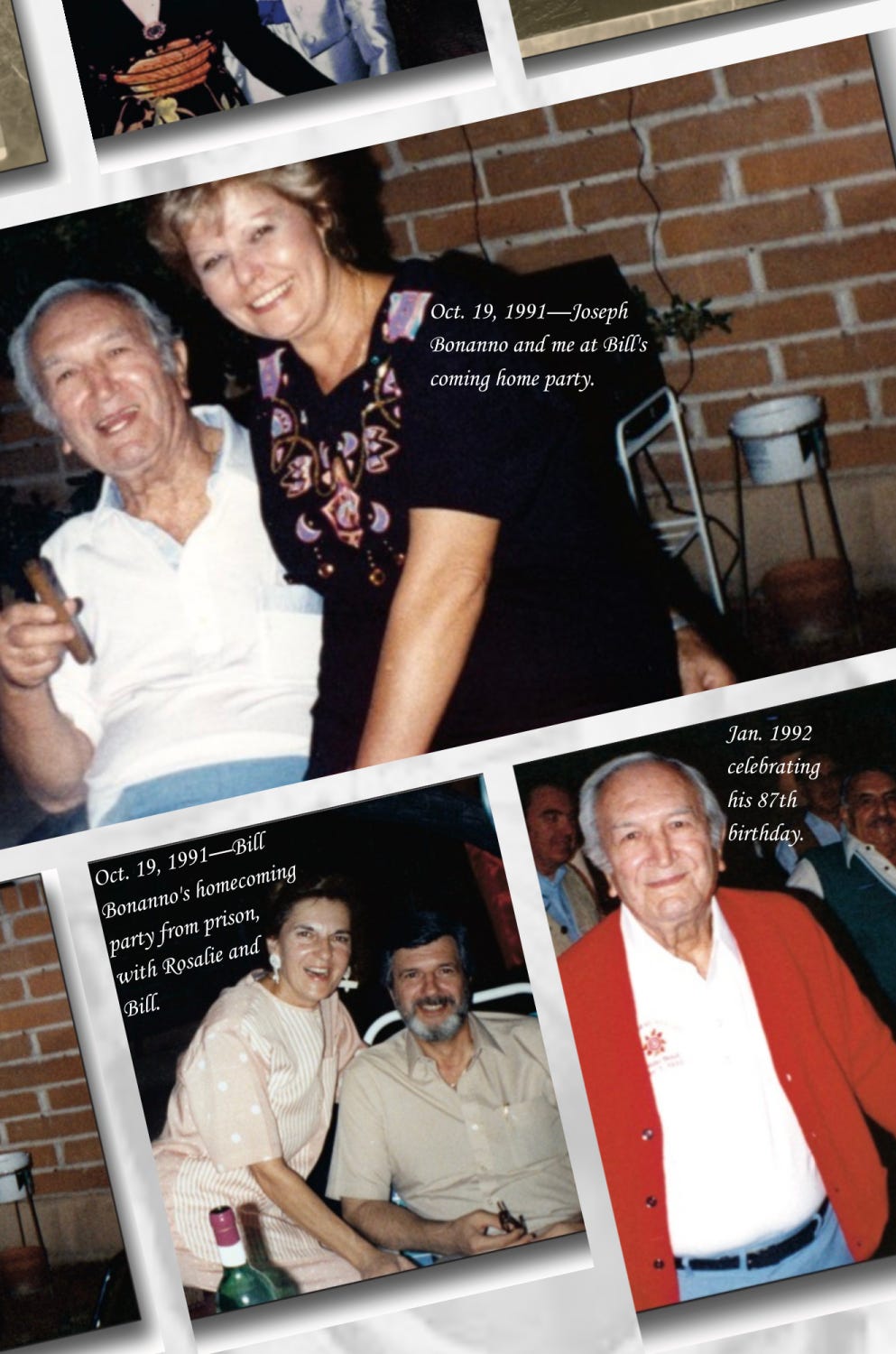
Larry is Lawrence D’Antonio, a prominent Tucson attorney, Bonanno’s lawyer and friend, whom she later married.
My initial meeting with Joseph Bonanno was in October of 1975. One evening after dinner, Larry asked me if I wanted to go with him to the Bonannos’ house, as Mr. Bonanno was a client and a friend of his. Although his suggestion surprised me, I agreed, and we went to his home, where we were greeted at the front door by Fay Bonanno, Joseph Bonanno’s wife.
She appeared to be a very simple, modest lady. As for Mr. Bonanno, who was then seventy, [he] was very distinguished-looking, well-built, with gray hair and a rosy complexion, and looked much younger than his age. We exchanged greetings and went into the family room where we were seated around a dining table.
Despite his reputation and public persona, I was comfortable, as I am not impressed by the world’s standards of what makes a person famous. Rather, I have always been drawn to people of knowledge and those with a good heart, and I found the Bonannos possessed both. Our conversation was about general topics, with the two men doing most of the talking.
Later in the evening, Mr. Bonanno began to engage me in a conversation that will always stay in my mind.
“Theresa, tell me, what do you know about organized crime, and what do you think?”
“Well,” I replied, “I really have no interest in organized crime. Of course it exists all over the world, but I am not at all curious about it; it just doesn’t interest me.”
He appeared to be satisfied with my response. It had been a very pleasant evening...
End.
Read the full story. The Last Don’s Mistress is available now. Read it free on Kindle, for a limited time: https://www.amazon.com/dp/1763723887 and (Australia) https://www.amazon.com.au/dp/B0HPJRSDTB Own the collector’s edition: hardcover and Bespoke Edition (gold foil, your name inside): Save 15% with code LinkedIn at checkout: https://trumpetpublishinghouse.com/collections/author-theresa-dantonio